Visiting Lecturer, Tufts University, Experimental College, Spring 2026.
Co-designed and co-taught with Ludo Cestarelli. [Link to Instructor spotlight]
Taste resists teaching. We built a course on a premise that sounds like a contradiction: that taste, the most subjective thing a person has, can be developed deliberately. In an age where AI generates infinite competent work, taste is what's left that's yours—it's your edge. So how do you teach it without flattening it into rules?
The Constraint: Tell students what good taste is and you've just prescribed your taste, not helped them find theirs. But pure "express yourself" has no rigour. We needed structure that sharpened judgment without dictating the answer.
What We Built
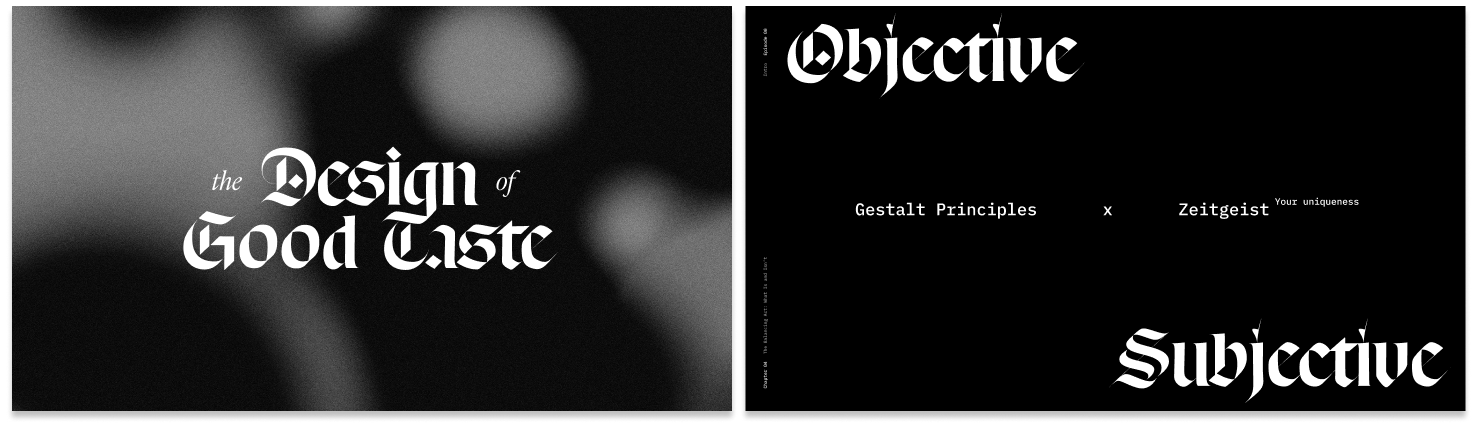
Two scaffolds, working against each other on purpose.
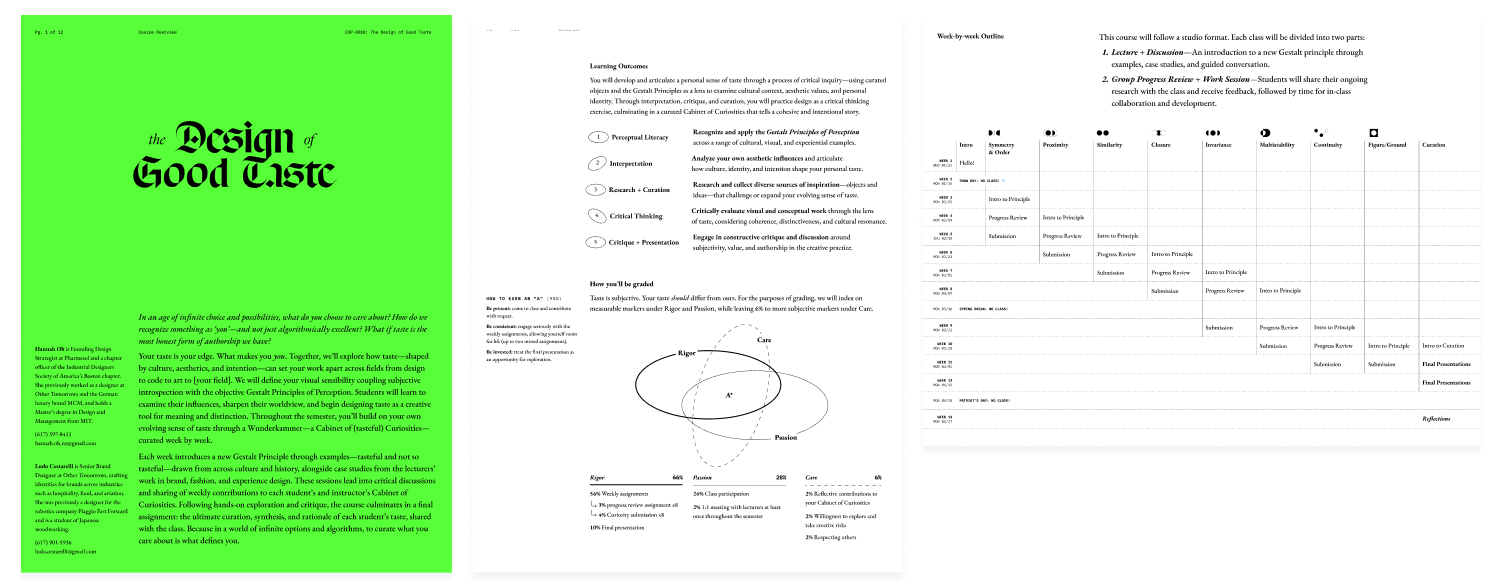
The objective one: the Gestalt Principles of Perception. Each week introduced one principle (symmetry, proximity, closure, and so on) through examples across art, fashion, and brand, including cases from our own work. This gave students a shared vocabulary for why something works, independent of whether they liked it.
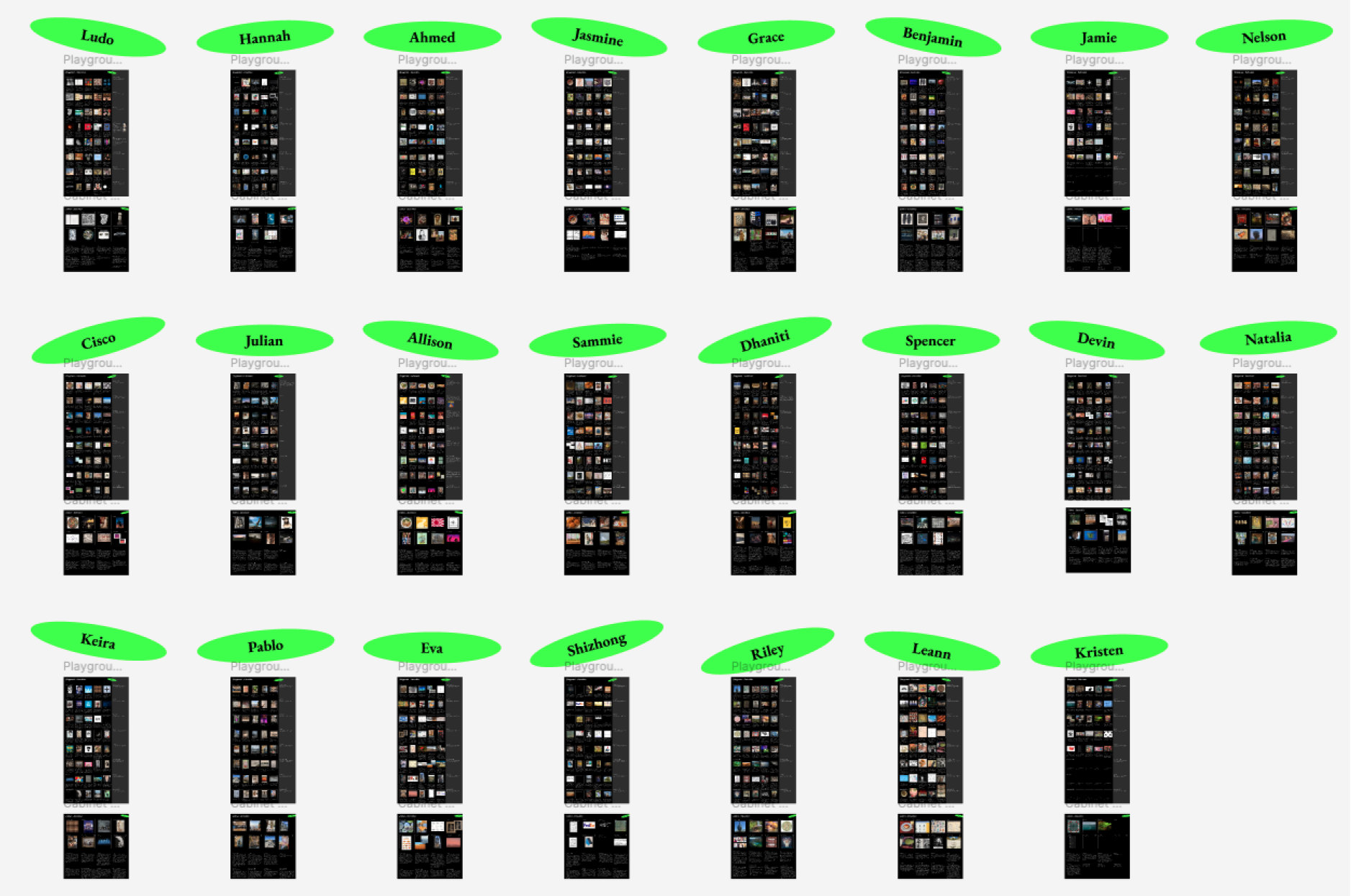
The subjective one: a Cabinet of Curiosities. Week by week, each student collected and curated objects that meant something to them on a shared Figma board, then defended their choices out loud. The principles gave them a lens; the Cabinet gave them a mirror. We even split the grading to match: measurable markers for rigor and participation, a small reserved slice for creative risk. Taste itself was never graded. Effort and inquiry were.
What We Couldn't Have Predicted
We went in with a hypothesis: across a class of students, would patterns emerge? Could we map something objective in the collective, a most-liked film, a shared aesthetic? The opposite happened. Taste got more specific, not less. One student was secretly an abacus enthusiast. One curated mimes. One watched clouds. Their curiosities weren't the popular films or the obvious brands. They went niche, personal, strange in the best way. The pattern wasn't convergence. It was that everyone who leaned in produced something unmistakably theirs.
Takeaways
1. Taste comes from appetite. The students who produced the most distinctive work were the ones willing to lean in and pay attention.
2. Structure doesn't kill subjectivity, it frees it. The objective scaffold gave students permission to be specific, because they had a language to defend their choices.
3. Sharing taste is teaching. Ludo and I made sure to complete all of the weekly assignments with the students to demonstrate this philosophy. To articulate why you love something or someone, you have to communicate how you see things.
That turned out to be the whole skill, and the thing AI can't do for you.